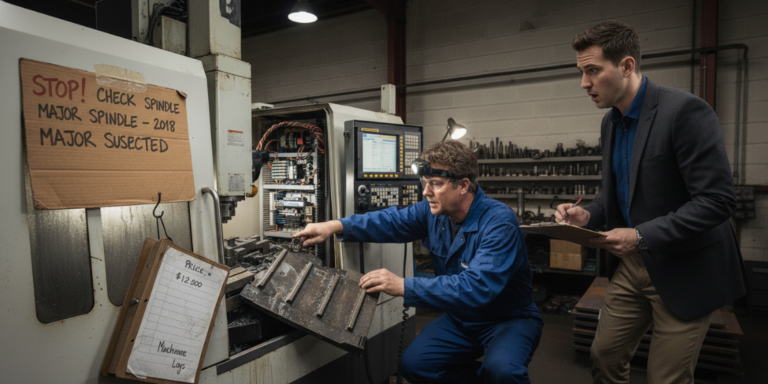
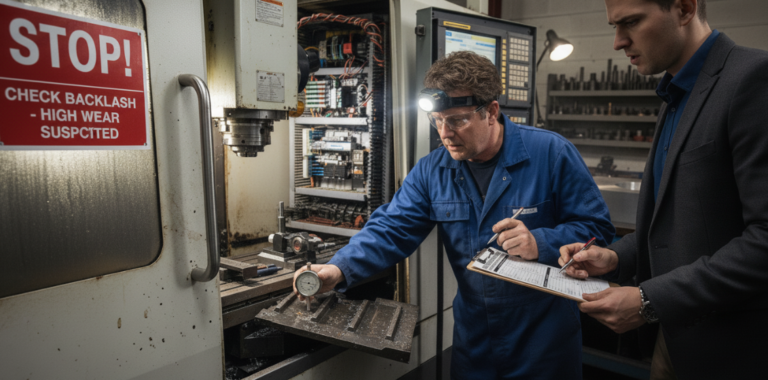
Buying a used CNC machine can be one of the smartest decisions for a manufacturing business — if you buy the right one.
The problem is not the machine.
The problem is missing one small detail that turns a “good deal” into an expensive mistake.
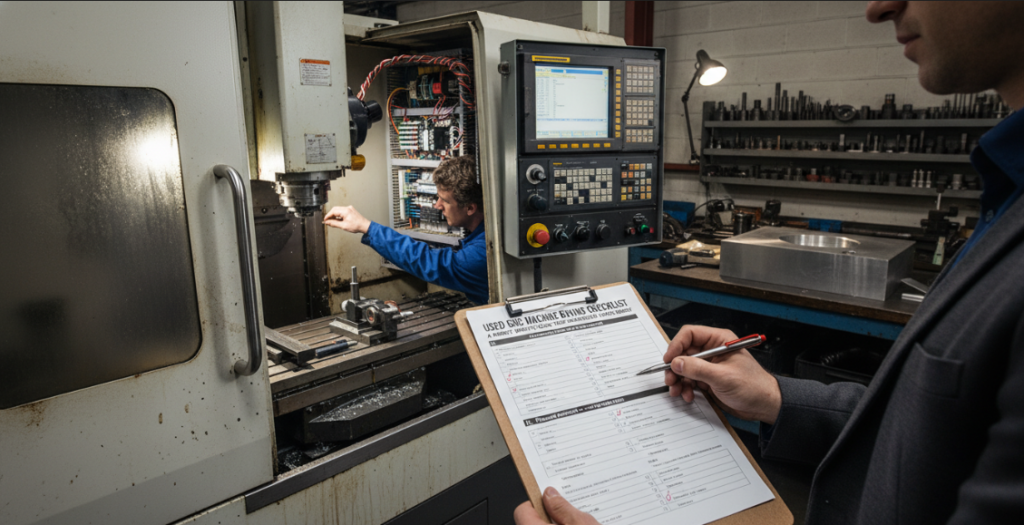
This checklist is written for real buyers — factory owners, job shops, entrepreneurs, and engineers — who want a clear, practical way to evaluate a used CNC machine without relying blindly on sellers.
Bookmark this guide. It will save you time, money, and stress.
Why You Need a Used CNC Machine Buying Checklist
Unlike new machines, every used CNC machine has:
- A different history
- A different wear pattern
- A different remaining life
Two machines of the same model can have completely different value.
A structured checklist helps you:
- Compare machines objectively
- Avoid emotional buying decisions
- Identify hidden costs early
- Negotiate with confidence
Step 1: Define Your Production Requirements (Before You Shop)
Before inspecting any used CNC machine, get clear on your needs.
Ask yourself:
- What materials will you machine?
- Required tolerances and accuracy
- Production volume (job work vs mass production)
- Available floor space and power supply
💡 Buying a machine that exceeds your needs often wastes money — buying one below your needs causes frustration.
Step 2: Verify the Used CNC Machine’s Basic Details
Start with facts, not promises.
Confirm:
- Machine brand and model
- Year of manufacture
- Serial number
- Controller type and version
- Country of origin
Cross-check this information with manufacturer documentation whenever possible.
Step 3: Understand the Machine’s Usage History
Usage matters more than age.
Ask for:
- Previous application (light job work or heavy production?)
- Operating hours (if available)
- Maintenance records
- Reason for sale
A used CNC machine from a low-stress application often has significantly more life left.
Step 4: Physical & Structural Inspection Checklist
Now inspect the machine body and structure.
Check:
- Rust on guideways or table
- Cracks or welding repairs
- Condition of covers and guards
- Signs of oil leakage
🚩 Heavy rust or structural repair is usually a deal breaker.
Step 5: Axis Movement & Guideway Condition
Precision starts with smooth motion.
Inspect:
- Smoothness of axis travel
- Abnormal noise or vibration
- Uneven movement at slow feed
If the machine struggles at low speed, accuracy issues may follow.
Step 6: Ball Screws & Backlash Evaluation
Ball screws are expensive to replace — inspect carefully.
Checklist:
- Measure backlash using a dial indicator
- Compare backlash across all axes
- Listen for knocking or grinding sounds
Even small backlash can lead to rejected parts and surface finish issues.
Step 7: Spindle Condition (Do Not Ignore This)
The spindle is the heart of a used CNC machine.
Check:
- Noise at different RPMs
- Vibration levels
- Tool clamping force
- Heat generation after running
🚩 Spindle issues can cost a significant portion of the machine’s value to fix.
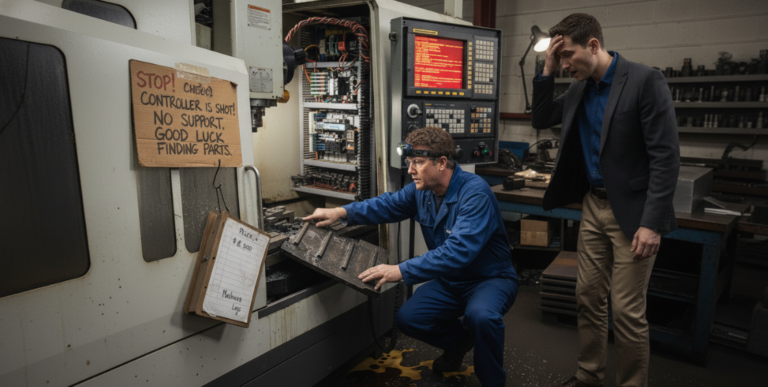
Step 8: Controller & Electrical System Checklist
Modern CNC machines depend heavily on electronics.
Inspect:
- Controller boot-up time
- Alarm history
- Button and keypad response
- Screen clarity
Also check:
- Electrical cabinet cleanliness
- Signs of overheating or burnt components
- Original vs modified wiring
Clean electrical systems usually reflect good maintenance habits.
Step 9: Lubrication & Cooling Systems
Proper lubrication extends machine life.
Checklist:
- Automatic lubrication functioning
- Oil reaching guideways and ball screws
- Coolant pump operation
- Leaks or blockages
Dry-running components shorten the remaining life of a used CNC machine dramatically.
Step 10: Tool Changer & Accessories
If the machine includes an ATC:
- Run multiple tool change cycles
- Check gripper condition
- Listen for unusual noise
Also confirm included accessories:
- Chip conveyor
- Coolant system
- Probing systems
- Rotary tables
Working accessories add real value.
Step 11: Accuracy Testing & Test Cuts
This is the most honest evaluation.
Perform:
- Repeatability tests
- Circular interpolation tests
- Test cuts on actual material (if possible)
A used CNC machine that performs well under test is worth serious consideration.
Step 12: Software, Parameters & Backup
Never buy without data security.
Confirm:
- Parameter backups
- Ladder logic access
- Compatibility with CAD/CAM software
Always take a full backup before finalizing the deal.
Step 13: Calculate the True Cost of Ownership
Purchase price is only one part of the cost.
Include:
- Transportation
- Installation
- Electrical work
- Initial maintenance
- Tooling upgrades
A cheap used CNC machine can become expensive if these are ignored.
Common Mistakes Buyers Make
Avoid these frequent errors:
- Skipping inspection due to urgency
- Trusting verbal assurances
- Ignoring backlash and spindle tests
- Underestimating repair costs
Smart buyers stay patient and methodical.
Quick Used CNC Machine Buying Checklist (Summary)
Before buying, confirm:
- ✔ Machine history & documentation
- ✔ Structural condition
- ✔ Axis movement & backlash
- ✔ Spindle health
- ✔ Controller & electronics
- ✔ Lubrication & cooling
- ✔ Tool changer & accessories
- ✔ Accuracy testing
- ✔ Software backup
- ✔ Total ownership cost
Final Thoughts: Buy With Confidence, Not Pressure
A used CNC machine can deliver excellent performance, fast ROI, and long-term value — but only when chosen carefully.
Use this checklist as your guide, take your time, and don’t rush the decision.
In the world of used CNC machines, knowledge is your strongest bargaining tool.
Continue Exploring
Discover more global buying guides, price insights, and expert resources at
UsedCNCMachineForSale.com
Buying a used CNC machine can be one of the smartest decisions for a manufacturing business — if you buy the right one.
The problem is not the machine.
The problem is missing one small detail that turns a “good deal” into an expensive mistake.
This checklist is written for real buyers — factory owners, job shops, entrepreneurs, and engineers — who want a clear, practical way to evaluate a used CNC machine without relying blindly on sellers.
Bookmark this guide. It will save you time, money, and stress.
Why You Need a Used CNC Machine Buying Checklist
Unlike new machines, every used CNC machine has:
- A different history
- A different wear pattern
- A different remaining life
Two machines of the same model can have completely different value.
A structured checklist helps you:
- Compare machines objectively
- Avoid emotional buying decisions
- Identify hidden costs early
- Negotiate with confidence
Step 1: Define Your Production Requirements (Before You Shop)
Before inspecting any used CNC machine, get clear on your needs.
Ask yourself:
- What materials will you machine?
- Required tolerances and accuracy
- Production volume (job work vs mass production)
- Available floor space and power supply
💡 Buying a machine that exceeds your needs often wastes money — buying one below your needs causes frustration.
Step 2: Verify the Used CNC Machine’s Basic Details
Start with facts, not promises.
Confirm:
- Machine brand and model
- Year of manufacture
- Serial number
- Controller type and version
- Country of origin
Cross-check this information with manufacturer documentation whenever possible.
Step 3: Understand the Machine’s Usage History
Usage matters more than age.
Ask for:
- Previous application (light job work or heavy production?)
- Operating hours (if available)
- Maintenance records
- Reason for sale
A used CNC machine from a low-stress application often has significantly more life left.
Step 4: Physical & Structural Inspection Checklist
Now inspect the machine body and structure.
Check:
- Rust on guideways or table
- Cracks or welding repairs
- Condition of covers and guards
- Signs of oil leakage
🚩 Heavy rust or structural repair is usually a deal breaker.
Step 5: Axis Movement & Guideway Condition
Precision starts with smooth motion.
Inspect:
- Smoothness of axis travel
- Abnormal noise or vibration
- Uneven movement at slow feed
If the machine struggles at low speed, accuracy issues may follow.
Step 6: Ball Screws & Backlash Evaluation
Ball screws are expensive to replace — inspect carefully.
Checklist:
- Measure backlash using a dial indicator
- Compare backlash across all axes
- Listen for knocking or grinding sounds
Even small backlash can lead to rejected parts and surface finish issues.
Step 7: Spindle Condition (Do Not Ignore This)
The spindle is the heart of a used CNC machine.
Check:
- Noise at different RPMs
- Vibration levels
- Tool clamping force
- Heat generation after running
🚩 Spindle issues can cost a significant portion of the machine’s value to fix.
Step 8: Controller & Electrical System Checklist
Modern CNC machines depend heavily on electronics.
Inspect:
- Controller boot-up time
- Alarm history
- Button and keypad response
- Screen clarity
Also check:
- Electrical cabinet cleanliness
- Signs of overheating or burnt components
- Original vs modified wiring
Clean electrical systems usually reflect good maintenance habits.
Step 9: Lubrication & Cooling Systems
Proper lubrication extends machine life.
Checklist:
- Automatic lubrication functioning
- Oil reaching guideways and ball screws
- Coolant pump operation
- Leaks or blockages
Dry-running components shorten the remaining life of a used CNC machine dramatically.
Step 10: Tool Changer & Accessories
If the machine includes an ATC:
- Run multiple tool change cycles
- Check gripper condition
- Listen for unusual noise
Also confirm included accessories:
- Chip conveyor
- Coolant system
- Probing systems
- Rotary tables
Working accessories add real value.
Step 11: Accuracy Testing & Test Cuts
This is the most honest evaluation.
Perform:
- Repeatability tests
- Circular interpolation tests
- Test cuts on actual material (if possible)
A used CNC machine that performs well under test is worth serious consideration.
Step 12: Software, Parameters & Backup
Never buy without data security.
Confirm:
- Parameter backups
- Ladder logic access
- Compatibility with CAD/CAM software
Always take a full backup before finalizing the deal.
Step 13: Calculate the True Cost of Ownership
Purchase price is only one part of the cost.
Include:
- Transportation
- Installation
- Electrical work
- Initial maintenance
- Tooling upgrades
A cheap used CNC machine can become expensive if these are ignored.
Common Mistakes Buyers Make
Avoid these frequent errors:
- Skipping inspection due to urgency
- Trusting verbal assurances
- Ignoring backlash and spindle tests
- Underestimating repair costs
Smart buyers stay patient and methodical.
Quick Used CNC Machine Buying Checklist (Summary)
Before buying, confirm:
- ✔ Machine history & documentation
- ✔ Structural condition
- ✔ Axis movement & backlash
- ✔ Spindle health
- ✔ Controller & electronics
- ✔ Lubrication & cooling
- ✔ Tool changer & accessories
- ✔ Accuracy testing
- ✔ Software backup
- ✔ Total ownership cost
Final Thoughts: Buy With Confidence, Not Pressure
A used CNC machine can deliver excellent performance, fast ROI, and long-term value — but only when chosen carefully.
Use this checklist as your guide, take your time, and don’t rush the decision.
In the world of used CNC machines, knowledge is your strongest bargaining tool.
Continue Exploring
Discover more global buying guides, price insights, and expert resources at
UsedCNCMachineForSale.com