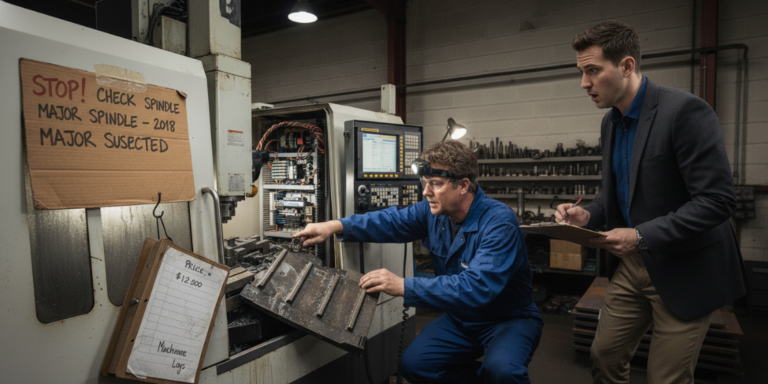
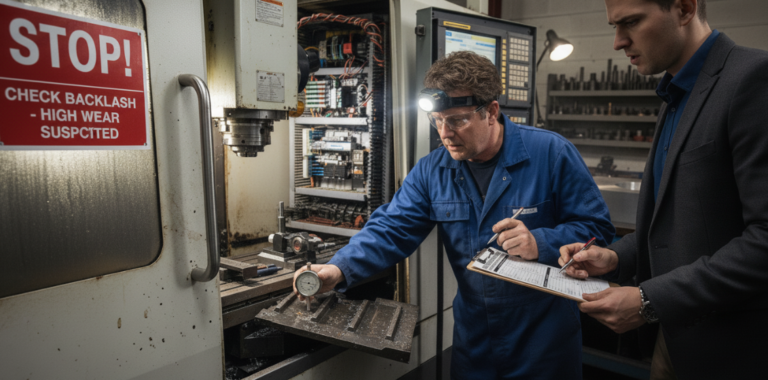
When buyers evaluate a used CNC machine, they usually ask:
- Does it power on?
- Does it jog smoothly?
- Is the price attractive?
And then they make one dangerous assumption:
👉 “The controller is good enough.”
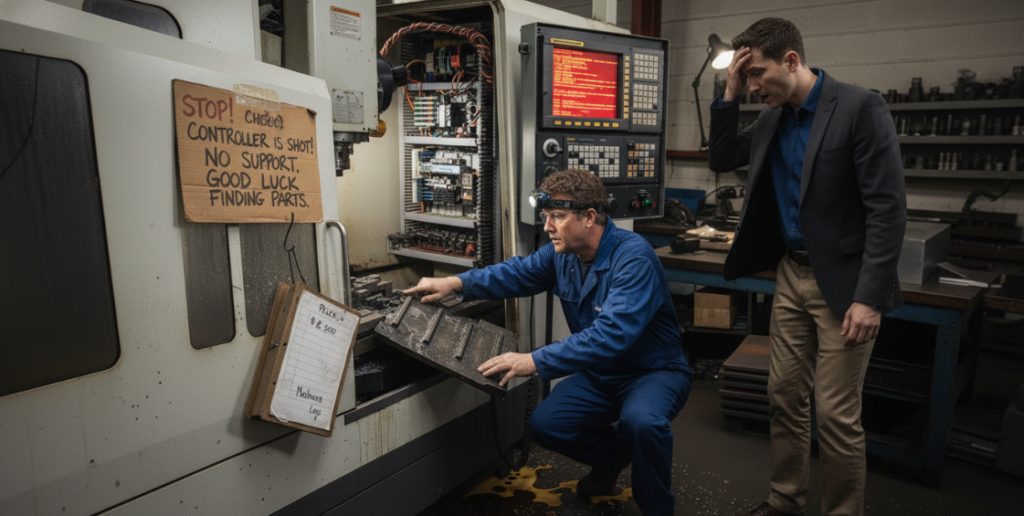
Assuming the controller is fine without deeper checks is one of the most common mistakes when buying used CNC machines, and it can limit productivity, increase downtime, and quietly kill ROI.
In this guide, we’ll explain why the CNC controller matters more than most buyers realize — and how to avoid this expensive mistake.
Why the CNC Controller Is the Brain of the Machine
The controller doesn’t just move axes.
It controls:
- Accuracy and repeatability
- Program execution
- Tool changes
- Alarms and safety systems
- Communication with modern software
A used CNC machine with a weak or outdated controller may run — but it may not run efficiently or reliably.
Why Buyers Assume the Controller Is “Fine”
This mistake happens because:
- The machine boots up normally
- The interface looks functional
- The seller says “no issues”
- Buyers lack controller-specific knowledge
Unfortunately, a controller can be technically working and still be a major problem.
“Working” Doesn’t Mean Suitable
A controller can power on and still suffer from:
- Slow processing speeds
- Limited memory
- Obsolete software versions
- Incompatible communication ports
These issues don’t show up during quick demos.
Hidden Problems with Older CNC Controllers
Many used CNC machines come with controllers that:
- Don’t support modern CAD/CAM files
- Lack USB or Ethernet connectivity
- Have discontinued spare parts
- Use outdated operating systems
Once something fails, repairs become expensive — or impossible.
Real Buyer Scenario: “It Runs, But It Can’t Keep Up”
A buyer installs a used CNC machine.
Problems appear:
- Programs load slowly
- Memory limits force code splitting
- Machining time increases
- Operators struggle with the interface
The controller works — but it’s holding the machine back.
Why Controller Compatibility Matters
Before buying a used CNC machine, buyers must consider:
- CAM software compatibility
- File size limits
- Network integration
- Automation readiness
Assuming the controller is “good enough” often means accepting future limitations.
Controller Upgrades Are Not Always Simple
Many buyers think:
“We’ll upgrade the controller later.”
In reality:
- Upgrades are costly
- Wiring and drives may need replacement
- Machine downtime is significant
- OEM support may no longer exist
Controller upgrades can cost nearly as much as the used CNC machine itself.
Common Controller-Related Red Flags
Watch for:
- Slow screen response
- Random alarms
- Long boot times
- Missing manuals or passwords
- Unsupported control brands
These are warning signs buyers often ignore.
Why Sellers Downplay Controller Issues
Controller problems are harder to explain and easier to hide.
Some sellers:
- Avoid loading large programs
- Skip explaining limitations
- Focus attention on mechanical condition
This makes controller issues one of the most overlooked common mistakes when buying used CNC machines.
How Smart Buyers Evaluate Controllers
Experienced buyers:
- Verify controller model and version
- Check OEM support availability
- Test program loading and execution
- Confirm software compatibility
- Ask about replacement part availability
They know the controller defines the machine’s long-term usability.
Price vs Controller Capability: A Risky Trade-Off
Choosing a cheaper used CNC machine with a weak controller often leads to:
- Higher operational costs
- Lower productivity
- Frustrated operators
- Reduced resale value
A slightly higher-priced machine with a capable controller often delivers better ROI.
Quick Controller Evaluation Checklist
Before buying a used CNC machine:
- ✅ Identify controller model & version
- ✅ Test program size limits
- ✅ Check connectivity options
- ✅ Verify OEM support
- ✅ Confirm CAM compatibility
Final Thoughts: “Good Enough” Is Rarely Enough
Assuming the controller is “good enough” is one of the most underestimated common mistakes when buying used CNC machines.
A used CNC machine may look solid mechanically — but if the controller can’t support your workflow, it becomes a bottleneck.
In the used CNC market, the controller determines what the machine can become — not just what it is today.
Continue Learning
Discover more expert insights on Common Mistakes When Buying Used CNC Machines, inspection guides, and buyer strategies at
UsedCNCMachineForSale.com
When buyers evaluate a used CNC machine, they usually ask:
- Does it power on?
- Does it jog smoothly?
- Is the price attractive?
And then they make one dangerous assumption:
👉 “The controller is good enough.”
Assuming the controller is fine without deeper checks is one of the most common mistakes when buying used CNC machines, and it can limit productivity, increase downtime, and quietly kill ROI.
In this guide, we’ll explain why the CNC controller matters more than most buyers realize — and how to avoid this expensive mistake.
Why the CNC Controller Is the Brain of the Machine
The controller doesn’t just move axes.
It controls:
- Accuracy and repeatability
- Program execution
- Tool changes
- Alarms and safety systems
- Communication with modern software
A used CNC machine with a weak or outdated controller may run — but it may not run efficiently or reliably.
Why Buyers Assume the Controller Is “Fine”
This mistake happens because:
- The machine boots up normally
- The interface looks functional
- The seller says “no issues”
- Buyers lack controller-specific knowledge
Unfortunately, a controller can be technically working and still be a major problem.
“Working” Doesn’t Mean Suitable
A controller can power on and still suffer from:
- Slow processing speeds
- Limited memory
- Obsolete software versions
- Incompatible communication ports
These issues don’t show up during quick demos.
Hidden Problems with Older CNC Controllers
Many used CNC machines come with controllers that:
- Don’t support modern CAD/CAM files
- Lack USB or Ethernet connectivity
- Have discontinued spare parts
- Use outdated operating systems
Once something fails, repairs become expensive — or impossible.
Real Buyer Scenario: “It Runs, But It Can’t Keep Up”
A buyer installs a used CNC machine.
Problems appear:
- Programs load slowly
- Memory limits force code splitting
- Machining time increases
- Operators struggle with the interface
The controller works — but it’s holding the machine back.
Why Controller Compatibility Matters
Before buying a used CNC machine, buyers must consider:
- CAM software compatibility
- File size limits
- Network integration
- Automation readiness
Assuming the controller is “good enough” often means accepting future limitations.
Controller Upgrades Are Not Always Simple
Many buyers think:
“We’ll upgrade the controller later.”
In reality:
- Upgrades are costly
- Wiring and drives may need replacement
- Machine downtime is significant
- OEM support may no longer exist
Controller upgrades can cost nearly as much as the used CNC machine itself.
Common Controller-Related Red Flags
Watch for:
- Slow screen response
- Random alarms
- Long boot times
- Missing manuals or passwords
- Unsupported control brands
These are warning signs buyers often ignore.
Why Sellers Downplay Controller Issues
Controller problems are harder to explain and easier to hide.
Some sellers:
- Avoid loading large programs
- Skip explaining limitations
- Focus attention on mechanical condition
This makes controller issues one of the most overlooked common mistakes when buying used CNC machines.
How Smart Buyers Evaluate Controllers
Experienced buyers:
- Verify controller model and version
- Check OEM support availability
- Test program loading and execution
- Confirm software compatibility
- Ask about replacement part availability
They know the controller defines the machine’s long-term usability.
Price vs Controller Capability: A Risky Trade-Off
Choosing a cheaper used CNC machine with a weak controller often leads to:
- Higher operational costs
- Lower productivity
- Frustrated operators
- Reduced resale value
A slightly higher-priced machine with a capable controller often delivers better ROI.
Quick Controller Evaluation Checklist
Before buying a used CNC machine:
- ✅ Identify controller model & version
- ✅ Test program size limits
- ✅ Check connectivity options
- ✅ Verify OEM support
- ✅ Confirm CAM compatibility
Final Thoughts: “Good Enough” Is Rarely Enough
Assuming the controller is “good enough” is one of the most underestimated common mistakes when buying used CNC machines.
A used CNC machine may look solid mechanically — but if the controller can’t support your workflow, it becomes a bottleneck.
In the used CNC market, the controller determines what the machine can become — not just what it is today.
Continue Learning
Discover more expert insights on Common Mistakes When Buying Used CNC Machines, inspection guides, and buyer strategies at
UsedCNCMachineForSale.com